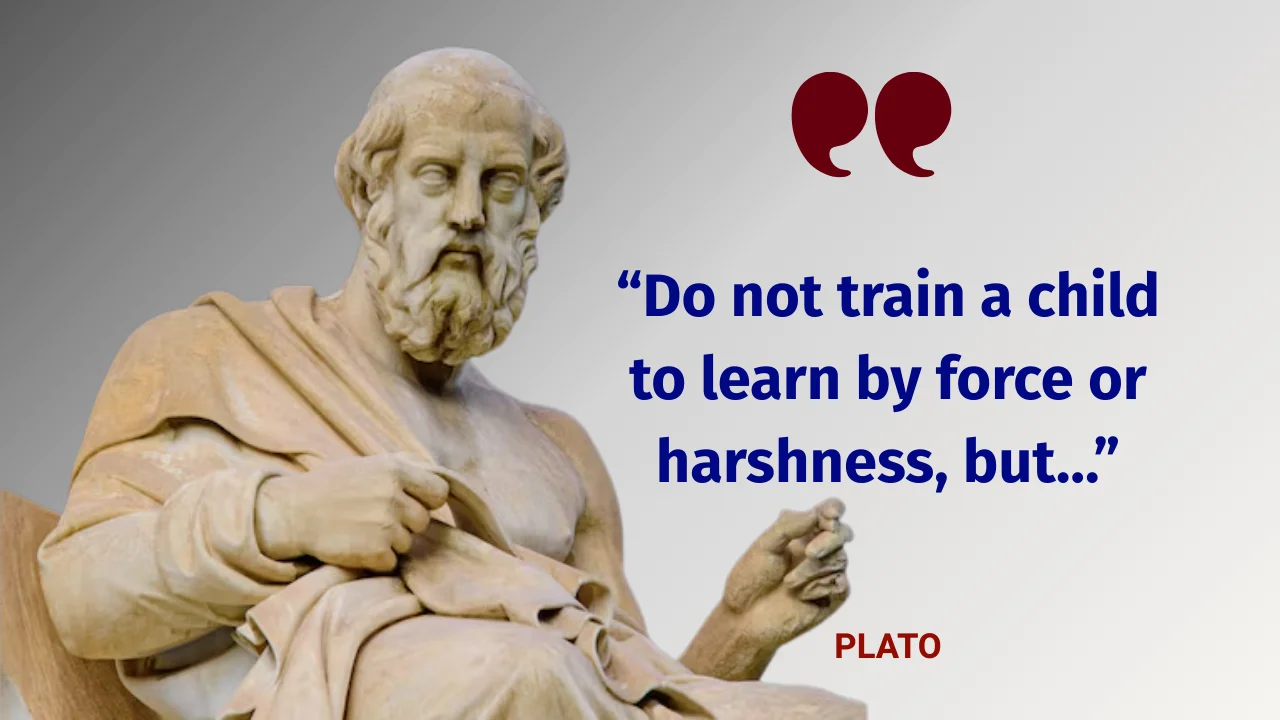
Plato Quote of the Day: Education has always been one of the most powerful tools for shaping a person’s life. Ancient philosophers often spoke about the right way to teach children, and their ideas still influence modern education. One powerful thought comes from Plato, who believed that children should learn in an environment that encourages curiosity and joy rather than fear or pressure. The Plato Quote of the Day reminds us that learning should be a positive experience that allows young minds to grow naturally. When we reflect on the Plato Quote of the Day, we begin to see education not as a forced activity but as a journey guided by interest and discovery.
Many parents and teachers still struggle with the balance between discipline and inspiration in education. This is where the Plato Quote of the Day becomes deeply meaningful. Plato advised that children should not be pushed to learn through harshness. Instead, they should be guided toward knowledge through activities that capture their attention and curiosity. This simple yet powerful idea has shaped many modern teaching philosophies and continues to inspire educators around the world.
Plato Quote of the Day
The Plato Quote of the Day carries a timeless message about how children should learn. Plato believed that education should not rely on fear, punishment, or strict pressure. Instead, he encouraged guiding children toward knowledge through curiosity, creativity, and enjoyment. According to this philosophy, when children are interested in a subject, they naturally become more focused and eager to learn.
Modern educational research supports the wisdom behind the Plato Quote of the Day. Studies in child psychology show that students learn better when they are engaged and emotionally connected to the learning process. Interactive teaching methods, storytelling, games, and practical activities help children absorb information more effectively. Plato’s message reminds us that learning is not simply about memorizing facts. It is about nurturing the mind and allowing curiosity to lead the way.
Overview of Plato’s Teaching Philosophy
| Key Aspect | Explanation |
| Philosopher | Plato, one of the most influential thinkers of ancient Greece |
| Core Idea | Children should learn through curiosity and interest |
| Teaching Approach | Encourage learning through enjoyable activities rather than force |
| Long Term Benefit | Builds creativity, confidence, and deeper understanding |
| Modern Influence | Inspires student centered learning and modern education systems |
Understanding the Meaning of the Quote
The Plato Quote of the Day highlights a fundamental truth about human learning. Children are naturally curious. They ask questions, explore their surroundings, and try to understand how things work. When education supports this natural curiosity, learning becomes easier and more meaningful.
However, when children are forced to learn through pressure or strict discipline, the experience can become stressful. Instead of enjoying knowledge, they may begin to associate learning with fear or boredom. The Plato Quote of the Day encourages parents and teachers to create a supportive environment where learning feels exciting rather than compulsory.
Plato’s View on Education
Plato believed that education was essential for building a healthy society. In his philosophical works, he explained that a well educated person is more capable of making wise decisions and contributing positively to the community.
For Plato, education was not only about academic knowledge. It also included character development, ethical thinking, and understanding the world. The Plato Quote of the Day reflects this deeper philosophy. Plato believed that teaching methods should respect the natural development of a child’s mind.
This approach aligns closely with modern educational theories that emphasize creativity, critical thinking, and emotional intelligence.
Why Children Should Not Be Forced to Learn
The message within the Plato Quote of the Day becomes clearer when we look at how children react to forced learning. Pressure based teaching methods can have several negative effects.
• Children may lose interest in learning
• Fear of mistakes can reduce confidence
• Creativity and independent thinking may decline
• Learning becomes a task rather than a discovery
When children feel safe and supported, they are more willing to experiment, ask questions, and explore new ideas. The Plato Quote of the Day reminds us that the goal of education is not just information but understanding.
The Power of Learning Through Curiosity
Curiosity plays a key role in intellectual development. A curious child does not need to be forced to study because the desire to learn comes naturally.
The wisdom behind the Plato Quote of the Day highlights the importance of creating learning environments where children can explore their interests. This can include reading stories, conducting experiments, solving puzzles, or engaging in discussions.
When children feel excited about learning, they become more active participants in the process. They remember information longer and develop stronger problem solving skills.
How Parents and Teachers Can Apply This Wisdom
Applying the lesson from the Plato Quote of the Day does not require complicated teaching methods. Simple changes in how adults guide children can make a big difference.
• Encourage curiosity by answering questions patiently
• Use stories and real life examples to explain concepts
• Allow children to explore subjects they enjoy
• Create a supportive environment where mistakes are part of learning
These approaches help children develop confidence and independence. They also build a positive relationship between students and teachers.
Relevance of Plato’s Quote in Modern Education
Even though Plato lived more than two thousand years ago, his ideas remain surprisingly relevant today. Many modern educational systems focus on student centered learning, which aligns closely with the message of the Plato Quote of the Day.
Schools now use interactive teaching methods, group projects, and creative assignments to engage students. Technology based learning platforms also follow this philosophy by making education more engaging and accessible.
The continuing popularity of the Plato Quote of the Day shows that ancient wisdom still holds value in modern classrooms.
Life Lessons from Plato’s Words
The Plato Quote of the Day teaches lessons that go beyond education. It reminds us that people learn best when they are motivated and interested in what they are doing.
This message applies to both children and adults. Whether learning a new skill, studying a subject, or building a career, curiosity and passion play a major role in success.
The quote encourages a mindset where learning becomes a lifelong journey rather than a forced responsibility.
FAQs
What does Plato’s quote about children mean?
The quote suggests that children should not be forced to learn through strict discipline. Instead, they should be guided toward knowledge through curiosity, enjoyment, and engaging activities that stimulate their interest.
Who was Plato and why are his ideas important?
Plato was an ancient Greek philosopher and a student of Socrates. His ideas about philosophy, politics, ethics, and education have influenced Western thought for centuries.
Why is curiosity important in education?
Curiosity encourages children to ask questions and explore ideas independently. When students are curious, they become active learners and retain knowledge more effectively.
How can parents apply Plato’s teaching philosophy at home?
Parents can support learning by encouraging curiosity, reading with children, discussing ideas openly, and allowing children to explore topics that interest them.
Is whey or plant protein better for muscle growth?
Both whey protein and plant based protein can support muscle growth when consumed in adequate amounts. Whey protein is quickly absorbed and contains a complete amino acid profile, while plant proteins like pea or soy can also support muscle development when combined properly in a balanced diet.