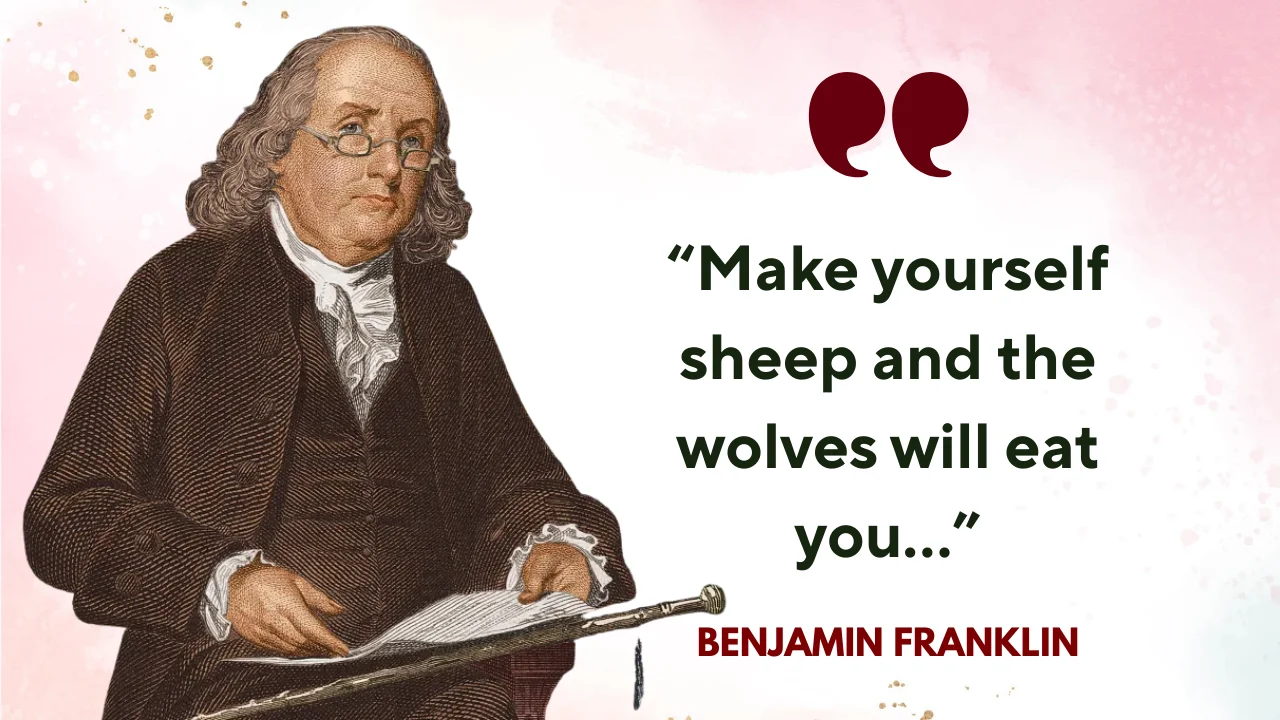
Make Yourself Sheep and the Wolves Will Eat You: Make yourself sheep and the wolves will eat you is one of the most powerful and thought provoking quotes connected to Benjamin Franklin. Even today, this short line continues to spark discussions about strength, leadership, and survival in a competitive world. The message behind Make yourself sheep and the wolves will eat you feels surprisingly modern because it reflects how people, organizations, and even nations interact when power and weakness collide.
In this article, we will explore the deeper meaning of Make yourself sheep and the wolves will eat you, the historical background surrounding Benjamin Franklin, and why this quote still matters in modern leadership, diplomacy, and personal growth. You will also discover how Franklin’s actions during the American Revolution reflected the wisdom behind his words and why many experts still reference this quote in discussions about strategy and resilience.
Make Yourself Sheep and the Wolves Will Eat You Meaning and Relevance
The quote Make yourself sheep and the wolves will eat you captures a universal truth about human nature and power. Franklin was pointing out that weakness often invites exploitation. When individuals or nations fail to defend themselves, stronger forces tend to dominate them. The wisdom behind Make yourself sheep and the wolves will eat you is not about aggression but about preparedness, confidence, and self respect.
In modern times, the quote is frequently referenced in leadership seminars, political analysis, and business discussions. Leaders use it to explain why strength and clear decision making matter. It also reminds people that respect often follows courage and determination. The message is simple but powerful. If people constantly act like sheep by avoiding responsibility or showing fear, the wolves in the world will take advantage. Franklin understood that diplomacy, strategy, and confidence help maintain balance in relationships and global politics.
Overview of the Quote and Its Historical Context
| Topic | Details |
| Quote Author | Benjamin Franklin |
| Famous Quote | Make yourself sheep and the wolves will eat you |
| Historical Era | 18th Century Enlightenment period |
| Key Theme | Strength versus weakness |
| Relevance Today | Leadership, diplomacy, and personal growth |
| Related Topics | American Revolution, diplomacy, political strategy |
| Franklin’s Role | Diplomat, inventor, writer, founding father |
| Core Message | Weakness invites exploitation |
| Modern Application | Leadership development and international relations |
| Popular Use | Inspirational and strategic discussions |
Political Involvement
Benjamin Franklin was far more than a scientist and inventor. His political influence shaped early American history in ways that still impact the world today. Before becoming deeply involved in revolutionary politics, Franklin built a reputation as a respected thinker, writer, and community leader.
He began his career as a printer and publisher in Philadelphia. Through his publications, Franklin shared ideas about education, public service, and civic responsibility. His famous Poor Richard’s Almanack became widely popular and helped spread practical wisdom across the American colonies.
Franklin also helped establish several institutions that improved society. These included libraries, fire departments, and educational organizations. His belief in knowledge and cooperation helped strengthen communities.
Over time, Franklin became involved in colonial politics. He represented Pennsylvania in negotiations with Britain and initially hoped to maintain peaceful relations between the colonies and the British government.
However, tensions grew when Britain introduced taxes and policies that angered the colonies. Events such as the Stamp Act created widespread protests. Franklin eventually realized that the relationship between Britain and the colonies was changing dramatically.
This shift pushed him toward supporting American independence. Franklin believed that freedom and self determination were essential if the colonies wanted to avoid becoming powerless in global politics. His thinking closely reflects the idea behind Make yourself sheep and the wolves will eat you, which warns against accepting weakness in the face of powerful forces.
Arrival in France
During the American Revolution, one of Franklin’s most important missions involved traveling to France. The young American colonies needed allies to defeat the British Empire, which was one of the most powerful nations in the world at the time.
Franklin arrived in France in 1776 as part of a diplomatic mission. His goal was to secure financial and military support for the American cause. This was not an easy task because France wanted to weaken Britain but also feared supporting a rebellion that could fail.
Franklin used his reputation and personality to gain influence in French society. Many French intellectuals admired him as a scientist and philosopher. His famous experiments with electricity had already made him internationally respected.
Instead of acting like a traditional diplomat, Franklin used charm and patience to build relationships with French leaders. He attended social gatherings, spoke with influential figures, and promoted the American cause with careful diplomacy.
Franklin understood that appearing confident and determined was essential for gaining support. His approach reflected the wisdom behind Make yourself sheep and the wolves will eat you. If the American colonies appeared weak or uncertain, France might refuse to help them.
By presenting America as capable and determined, Franklin gradually gained the trust of the French government.
Advocating for America
Franklin spent years working tirelessly to convince France that supporting the American Revolution would benefit them. At first, French leaders offered secret assistance in the form of supplies and financial aid.
The turning point came in 1777 after the American victory at the Battle of Saratoga. This victory proved that the colonial army could defeat British forces.
Franklin used this opportunity to push for a formal alliance between France and the United States. His diplomatic skill helped secure the Treaty of Alliance in 1778.
This agreement brought major benefits to the American cause. France provided ships, soldiers, weapons, and financial support. Without this assistance, defeating Britain would have been extremely difficult.
Franklin’s calm leadership and strategic thinking helped maintain strong relations with French officials throughout the war. He also managed disagreements among American representatives, ensuring that diplomacy remained focused.
The success of these negotiations demonstrated the real world application of Make yourself sheep and the wolves will eat you. By showing resilience and strength, the colonies earned respect and crucial support from a powerful ally.
France Agrees to Support the Revolution
French support played a decisive role in the final outcome of the American Revolution. French naval forces helped challenge British control of the seas, while financial assistance strengthened the American military effort.
Franklin remained in France for several years to manage the alliance and maintain diplomatic stability. His ability to build trust with French leaders ensured that support continued during difficult moments in the war.
In 1783, peace negotiations between the United States and Britain led to the Treaty of Paris. Franklin participated in these negotiations alongside other American leaders.
The treaty officially recognized the independence of the United States and ended the Revolutionary War. Franklin’s diplomatic contributions helped secure favorable terms for the new nation.
His success showed that wisdom, confidence, and patience can influence world events. Franklin’s actions demonstrated that the lesson behind Make yourself sheep and the wolves will eat you applies not only to individuals but also to nations seeking independence and respect.
FAQs
What does the quote “Make yourself sheep and the wolves will eat you” mean?
The quote means that weakness invites exploitation. Franklin believed that people and nations must show strength and confidence to avoid being dominated by stronger forces.
Why is Benjamin Franklin an important historical figure?
Benjamin Franklin was a founding father of the United States, a scientist, inventor, diplomat, and writer who played a major role in the American Revolution and the creation of the new nation.
How did Franklin help America during the Revolutionary War?
Franklin secured crucial support from France through diplomacy. French military and financial assistance helped the American colonies defeat Britain.
Why is Franklin’s quote still relevant today?
The quote is often used to discuss leadership, business strategy, and international relations because it highlights the importance of confidence and strength.
How can people apply Franklin’s quote in everyday life?
People can apply the message by developing confidence, standing up for their values, and avoiding situations where they allow others to take advantage of them.